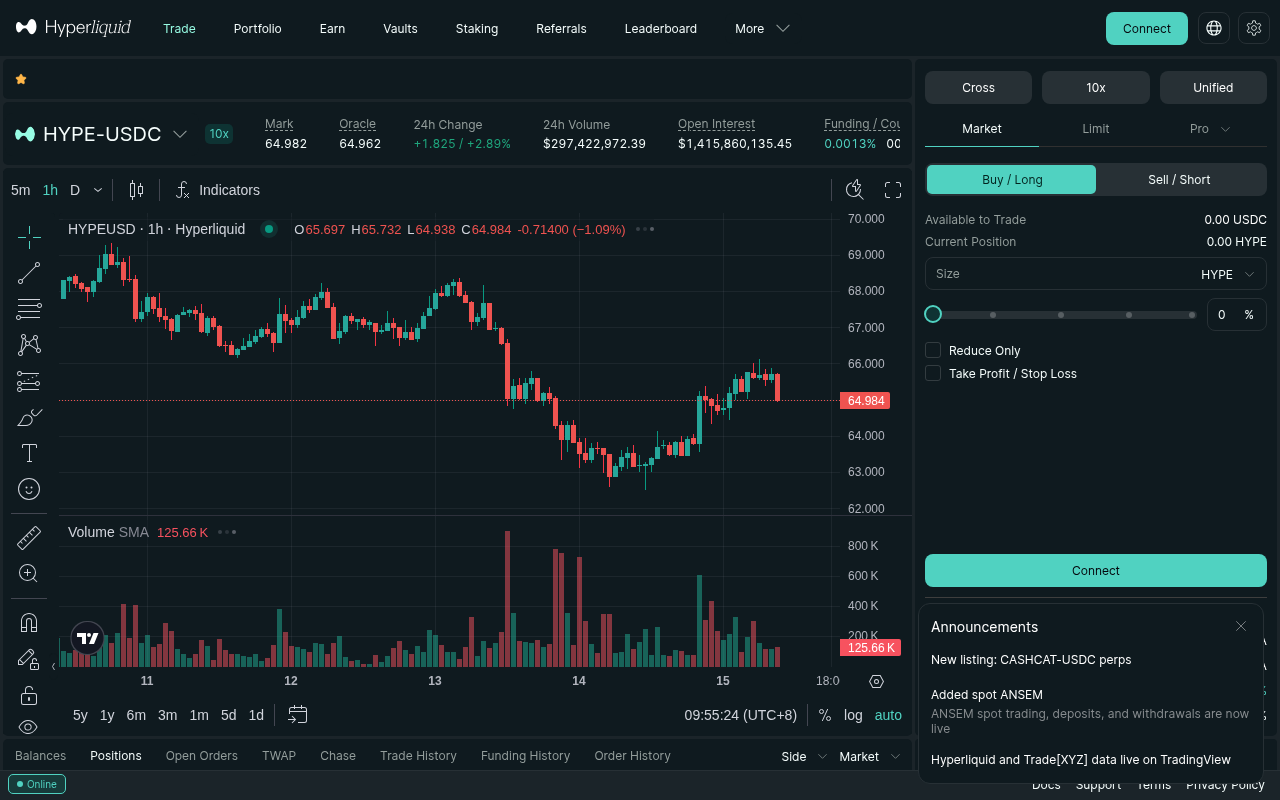
If you trade on Hyperliquid, your physical location might matter more than your strategy. Glassnode research published on March 30, 2026 revealed that all 24 Hyperliquid validators sit in AWS Tokyo (ap-northeast-1), giving Tokyo-based traders a roughly 200-millisecond latency advantage over traders in Europe and the United States.
On a time-priority order book โ where the first order to arrive at a given price gets filled first โ 200 milliseconds is not trivial. Over thousands of trades, that gap compounds into better fills, tighter effective spreads, and measurably higher P&L.
This guide breaks down the Glassnode findings, explains exactly why geography matters on Hyperliquid, and walks through six practical steps to reduce your latency โ whether you're a casual trader or running an automated bot.
Why All Hyperliquid Validators Are in Tokyo
Hyperliquid may be decentralized at the protocol level, but its physical infrastructure is concentrated. According to Glassnode's latency probes and validator metrics:
- 24 validators are clustered across multiple availability zones inside AWS ap-northeast-1 (Tokyo)
- The API layer routes through AWS CloudFront (a global CDN), but the matching engine and validators sit in a single Japanese cloud region
- Raw network latency from Tokyo to the validators is only 2โ3 milliseconds
But here's the critical point: Hyperliquid runs a time-priority order book. Unlike price-time-priority on some centralized exchanges where market makers get special queue positions, Hyperliquid's matching is purely first-come-first-served at each price level. Geography directly determines queue position.
The Glassnode Numbers: How Big Is the Gap?
Glassnode deployed latency probes across multiple global locations and measured real order-to-fill round-trip times. Here's what they found:
| Location | Network Latency to Validators | Median Order-to-Fill | Total Round-Trip |
|---|---|---|---|
| Tokyo (AWS ap-northeast-1) | ~2โ3 ms | ~884 ms | ~884 ms |
| Ashburn, Virginia (US East) | ~160โ200 ms | ~1,079 ms | ~1,079 ms |
| Europe | ~200+ ms | ~1,100+ ms | ~1,100+ ms |
1. Server-side processing dominates: About 879 ms of the Tokyo round-trip is server-side processing, not network transit. This means the matching engine itself takes most of the time.
2. Network transit is the variable: From Tokyo, network transit is ~5 ms. From the US, it's ~200 ms. That 195 ms difference is what creates the geographic edge. 3. The edge is consistent: Unlike random jitter, geographic latency is a fixed physics constraint. Speed of light through fiber optic cable doesn't change. Tokyo traders get this advantage on every single order.What 200ms Means in Practice
For a single trade, 200 ms probably doesn't matter. You place a market buy on ETH-USDC, you get filled either way.
But in these scenarios, it matters a lot:
- Aggressive limit orders competing at the same price: If you and a Tokyo trader both try to post a limit buy at $3,450.00, the Tokyo order arrives first and gets filled first. Your order sits behind in the queue.
- Market-making: Posting and canceling hundreds of orders per minute. 200 ms slower means your stale quotes get picked off before you can cancel them.
- Arbitrage: Cross-venue arb between Hyperliquid and Binance/OKX. The Tokyo-based trader can read the HL book state and react faster.
- Liquidation sniping: When a large position gets liquidated, the resulting market order fills against the best resting orders. Closer traders have better queue position to catch liquidation flow.
6 Ways to Reduce Your Hyperliquid Latency
1. Run a VPS in AWS Tokyo (ap-northeast-1)
The single most impactful change. Instead of sending orders from your home computer in New York or London, run your trading bot on a virtual private server in the same AWS region as the validators.
Cost: An AWS EC2c6i.xlarge (4 vCPUs, 8 GB RAM) in ap-northeast-1 costs roughly $0.17/hour or about $124/month. For serious trading, that's a rounding error.
Setup:
1. Create an AWS account and launch an EC2 instance in ap-northeast-1 (Tokyo)
2. Choose a compute-optimized instance (c6i or c7g family) โ you want fast single-core performance
3. Install your trading bot, configure it to use Hyperliquid's API endpoint
4. Your network latency drops from 160โ200 ms to approximately 2โ5 ms
Pro tip: Try different availability zones within ap-northeast-1 (1a, 1c, 1d). Glassnode's latency map at hyperlatency.glassnode.com shows per-AZ measurements so you can pick the fastest one.
2. Run a Non-Validating Node
This is Hyperliquid's official recommendation for latency-sensitive traders. Instead of querying the public API (which goes through CloudFront), you run your own node that syncs directly with validators.
Why it's faster: A non-validating node receives block data directly from validator peers โ no CDN hops, no API rate limits, and you get exchange state updates the moment blocks are executed rather than waiting for API propagation. How to set it up (from Hyperliquid's official docs):
# On your AWS Tokyo VPS
# Download hl-visor (Hyperliquid's node software)
curl https://binaries.hyperliquid.xyz/Testnet/hl-visor -o ~/hl-visor
chmod +x ~/hl-visor
# Configure for mainnet
echo '{"chain": "Mainnet"}' > ~/visor.json
# Run the non-validating node
~/hl-visor run-non-validator
Connect to a reliable peer: Hyperliquid recommends connecting to the Hyper Foundation's non-validating node for fewer hops to validators. The Foundation node IP is available in the official docs.
Machine specs (minimum for low latency):- 32 logical cores (more cores = faster block execution)
- 500 MB/s disk throughput (NVMe SSD recommended)
- 16+ GB RAM
3. Build Local Order Book State
Once you're running a non-validating node, stop querying the API for order book data. Instead, construct the book locally from node outputs.
Hyperliquid provides an open-source example: github.com/hyperliquid-dex/order_book_server
This server:
- Reads block outputs directly from your local node
- Reconstructs the full order book in memory
- Gives you microsecond-level access to current book state
4. Use Node Optimization Flags
Two flags that matter for latency:
--disable-output-file-buffering: Gets block outputs written immediately instead of waiting for the OS file buffer to flush. You see new blocks as soon as they're executed.
--batch-by-block: Waits until the entire block is processed before writing data. The order book server example above uses this for simpler logic. For even lower latency, you can turn this off and infer block boundaries yourself โ but it adds complexity.
5. Cancel Orders via Nonce Invalidation (Not Cancel Actions)
This is a subtle but powerful optimization from Hyperliquid's official docs. Instead of sending a cancel order request (which consumes API rate limits and may not land immediately), you can invalidate the order's nonce.
How it works: Send anoop transaction that bumps your nonce past the pending order's nonce. If the noop lands first, the original order becomes invalid. This:
- Saves on user rate limits
- Has a guaranteed success rate (if the nonce invalidation lands first)
- Is faster than waiting for a cancel confirmation
6. Optimize Your Network Path
Even within Tokyo, not all paths are equal:
- Use AWS Direct Connect if you're colocating hardware alongside your VPS
- Avoid VPN layers that add encryption/decryption overhead
- Use TCP keep-alive on WebSocket connections to avoid re-establishing connections
- Consider AWS Placement Groups to minimize inter-AZ latency if your node and trading bot run on separate instances
How These Optimizations Stack Up
| Optimization | Estimated Latency Reduction | Cost | Difficulty |
|---|---|---|---|
| AWS Tokyo VPS | -150 to -200 ms (from US/EU) | ~$125/month | Easy |
| Non-validating node | -50 to -100 ms (vs public API) | Same VPS, larger instance | Medium |
| Local order book | -10 to -50 ms (data access) | Same VPS | Medium |
| Node optimization flags | -5 to -20 ms | Free | Easy |
| Nonce invalidation | Variable (saves rate limits) | Free | Medium |
| Network path optimization | -1 to -5 ms | Variable | Advanced |
Does This Mean Non-Tokyo Traders Are at a Permanent Disadvantage?
Yes and no.
Yes, for speed-dependent strategies: If your edge relies on being first in the queue (market-making, arb, liquidation sniping), Tokyo proximity is table stakes. You either colocate in AWS Tokyo or you lose to someone who does. No, for most trading styles: If you trade on 5-minute or higher timeframes, make directional bets based on analysis, or use limit orders with patience, 200 ms is irrelevant. Your edge is analytical, not speed-based.The Glassnode data also shows that server-side processing (879 ms) dominates total latency. Even in Tokyo, your order takes nearly a second to process. This is orders of magnitude slower than centralized exchanges like Binance (~1-5 ms matching) or traditional stock exchanges (~microseconds). Hyperliquid's consensus mechanism adds inherent latency that no amount of colocation can eliminate.
This means Hyperliquid is NOT a venue for microsecond-level HFT. The speed competition happens at the 800โ1100 ms scale, not the 1โ10 ms scale. That's actually good news for retail traders โ the latency gap is meaningful but not insurmountable.
Will This Change? Hyperliquid's Infrastructure Roadmap
Hyperliquid's validator concentration in a single region is a known centralization trade-off. The team has prioritized performance over geographic distribution, which is why all 24 validators share one AWS region.
Future possibilities:
- Multi-region validators: If Hyperliquid adds validators in US and European AWS regions, latency would equalize. But this adds consensus overhead (cross-region communication) and could increase overall processing time.
- More validators: Currently 24 validators. More validators could be added in different regions as the network matures.
- Optimized consensus: Hyperliquid's custom HyperBFT consensus is already fast. Future protocol upgrades could reduce the ~879 ms server-side processing time.
Quick Start: Your Latency Optimization Checklist
If you're running automated trades on Hyperliquid, here's the priority order:
- [ ] Check your current latency at hyperlatency.glassnode.com
- [ ] Spin up an AWS EC2 instance in ap-northeast-1 (Tokyo) โ compute-optimized, c6i.xlarge minimum
- [ ] Move your trading bot to the Tokyo VPS
- [ ] Set up a non-validating node on the same VPS using
hl-visor run-non-validator - [ ] Connect to Hyper Foundation's node as your peer for reliable validator access
- [ ] Build local order book using order_book_server if you need real-time book data
- [ ] Enable
--disable-output-file-bufferingfor fastest block data access - [ ] Switch to nonce invalidation for order cancellations if you're market-making
Final Thoughts
The Glassnode research confirmed what infrastructure-savvy traders already suspected: Hyperliquid's matching engine has a physical home, and proximity to that home matters. Tokyo traders enjoy a ~200 ms edge that translates into better queue position on every order.
But context matters. This advantage is most relevant for automated strategies competing at the speed frontier. For directional traders, swing traders, and anyone operating on timeframes above a few minutes, your analytical edge dwarfs any latency difference.
The actionable takeaway: if you're building a trading bot for Hyperliquid, host it in AWS Tokyo. The $125/month for a VPS is the cheapest alpha you'll find anywhere in crypto.
---
*Ready to start trading on Hyperliquid? Create your account here โ referral code RICH888 saves you on fees.*
*Already trading on Hyperliquid? Check out our guide to Hyperliquid cross margin vs isolated margin and how to save with zero-fee trading.*