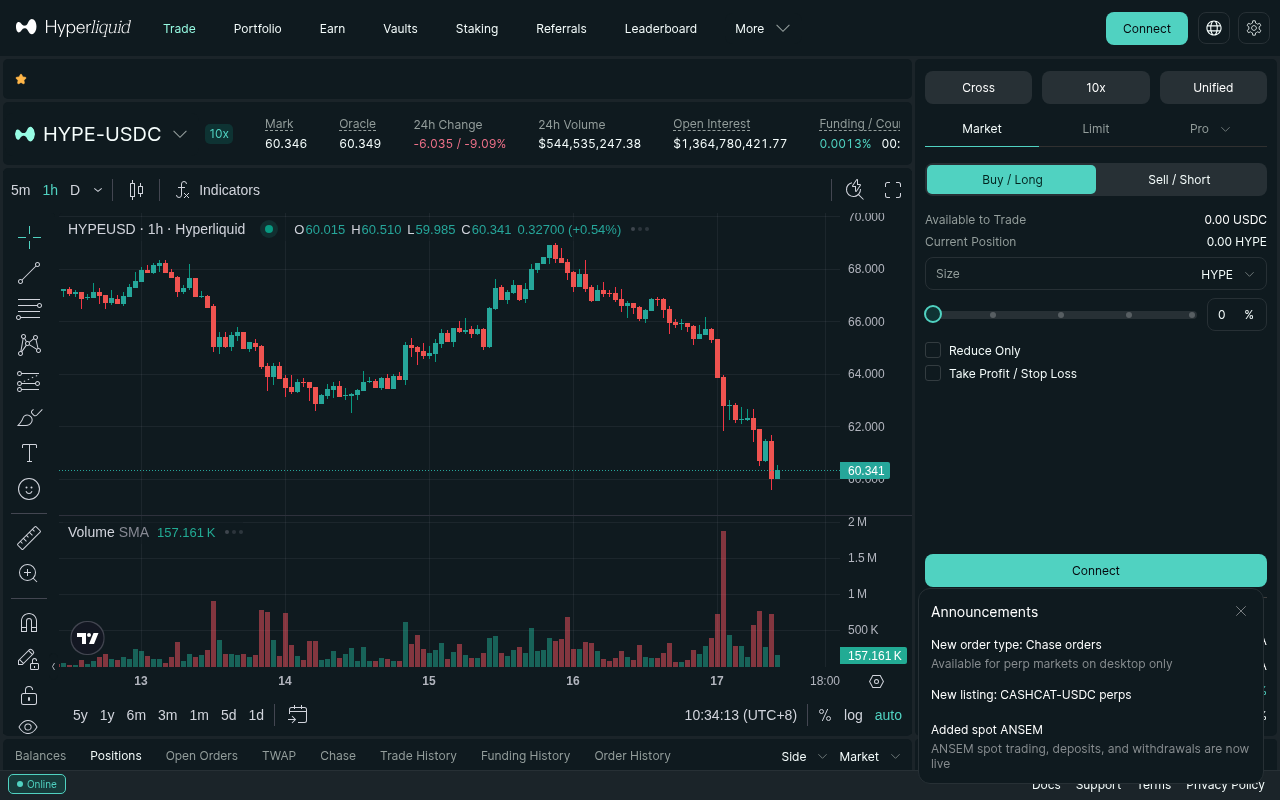
*Evidence: Logged-out mainnet public UI, captured and refreshed automatically each week. Official source.*
Position sizing is the single most important skill separating traders who survive from traders who don't. Yet most guides either throw a formula at you with zero context, or hand-wave with "just risk 1-2%." Neither is useful when you are staring at an order form on OKX or Hyperliquid at 2 AM.
This guide walks through exactly how to calculate your position size — with real numbers, real scenarios, and a free position size calculator you can use right now.
---
Why Position Sizing Matters More Than Your Entry
Here is a thought experiment. Two traders both go long ETH at ,500:
- Trader A risks 2% of a ,000 account per trade. Stop loss at ,400 (2.86% away). Position size: ,500.
- Trader B yeets 80% of a ,000 account into the same trade at 10x leverage. No stop loss.
Same entry. Same asset. Same direction. Completely different outcomes. The difference is position sizing.
The core principle: decide how much you can lose *before* you decide how much to buy.---
The Position Sizing Formula (Explained Simply)
Every position size calculation boils down to three variables:
Let me break each piece down.
1. Risk Amount: How Much Can You Afford to Lose?
This is a percentage of your total trading account. The standard range:
| Risk Tolerance | Per-Trade Risk | Who It Suits |
|---|---|---|
| Conservative | 0.5–1% | Full-time traders, large accounts |
| Moderate | 1–2% | Most traders (recommended) |
| Aggressive | 2–5% | Small accounts, high-conviction setups |
| Reckless | 5%+ | Gamblers (not recommended) |
The 2% rule is not a law of physics — it is a survival heuristic. At 2% risk, you need 50 consecutive losing trades to blow your account. At 10% risk, you need 10. Which streak is more likely to happen?
2. Stop Loss Distance: Where Are You Wrong?
Your stop loss should be placed at a price level where your trade thesis is invalidated — not at some arbitrary percentage.
Good stop loss placements:
- Below the previous swing low (for longs)
- Above the previous swing high (for shorts)
- Below a key support/resistance level
- Below a moving average that defines the trend
- "5% below entry because someone on Reddit said so"
- No stop loss at all ("I will exit manually" — no you will not)
3. Putting It Together
Full example:
- Account: ,000
- Risk per trade: 2% =
- Entry: BTC at ,000
- Stop loss: ,000 (distance = 2.38%)
So your total BTC position should be worth ,202. If BTC hits your stop loss at ,000, you lose exactly — your predefined risk amount.
---
Position Sizing With Leverage
Leverage does not change your risk — it changes your margin requirement. This is where most traders get confused.
How Leverage Actually Works
When you use 10x leverage on a ,202 position:
- Total position value: ,202 (unchanged)
- Required margin (collateral): .20
- Risk if stopped out at ,000: Still
The Dangerous Mistake
Here is what actually happens when people misuse leverage:
"I have ,000 and 10x leverage, so I can open a ,000 position!"
A ,000 BTC position at 10x leverage:
- Margin used: ,000 (your entire account)
- Liquidation price: roughly 8-10% away from entry (varies by exchange)
- A normal 5% BTC move wipes out ~,500 — half your account
Step-by-Step With Leverage
- Calculate position size normally: ,202 (from our earlier example)
- Choose leverage: 5x
- Required margin: ,202 ÷ 5 = .40
- Risk if stopped out: still (2% of account)
---
Real-World Position Sizing: OKX Example
Let me walk through an actual trade setup on OKX.
Scenario: You want to go long SOL perpetual futures.| Parameter | Value |
|---|---|
| Account balance | ,000 |
| Risk per trade | 2% () |
| SOL entry price | .00 |
| Stop loss | .00 (below support) |
| Stop loss distance | .00 / .00 = 3.70% |
| Leverage | 5x |
On OKX order form:
- Set leverage to 5x
- Order type: Limit
- Quantity: 8 SOL
- Price: .00
- Set stop loss: .00
Your margin usage is out of ,000 — only 10.8% of your account is tied up as collateral. The rest stays liquid for other trades or as a buffer against liquidation.
---
Like what you're reading? Try it yourself — this link supports ChartedTrader at no cost to you.
Sign up on OKX with fee discount →Real-World Position Sizing: Hyperliquid Example
Hyperliquid works the same way, but with some DEX-specific nuances. Scenario: Short ETH perpetuals on Hyperliquid.| Parameter | Value |
|---|---|
| Account balance | ,000 |
| Risk per trade | 1.5% () |
| ETH entry price | ,800 |
| Stop loss | ,900 (above resistance) |
| Stop loss distance | / ,800 = 2.63% |
| Leverage | 3x |
Hyperliquid-specific considerations:
- Use cross margin if you have other open positions (shared collateral)
- Use isolated margin if you want this trade ring-fenced (recommended for beginners)
- On Hyperliquid, maker orders (limit orders that rest on the book) are free (as of 2026-04) — so use limit orders to save on fees
- Check the funding rate before opening: if you are long and funding is positive, you pay every 8 hours
The Position Sizing Cheat Sheet
For quick reference, here are position sizes for common scenarios at 2% risk:
,000 Account (Risk per trade)
| Stop Loss Distance | Position Size | At 5x Leverage (Margin) |
|---|---|---|
| 1% | ,000 | |
| 2% | ,000 | |
| 3% | ||
| 5% | ||
| 10% |
,000 Account (Risk per trade)
| Stop Loss Distance | Position Size | At 5x Leverage (Margin) |
|---|---|---|
| 1% | ,000 | ,000 |
| 2% | ,000 | ,000 |
| 3% | ,333 | |
| 5% | ,000 | |
| 10% | ,000 |
,000 Account (Risk per trade)
| Stop Loss Distance | Position Size | At 5x Leverage (Margin) |
|---|---|---|
| 1% | ,000 | ,000 |
| 2% | ,000 | ,000 |
| 3% | ,667 | ,333 |
| 5% | ,000 | |
| 10% | ,000 |
---
Advanced Position Sizing Techniques
Once you have the basics down, there are three techniques that professional traders use.
1. Volatility-Based Sizing (ATR Method)
Instead of using a fixed percentage stop loss, use the Average True Range (ATR) to adapt to market volatility.
Example: BTC 14-day ATR is ,500. Using a 1.5× ATR multiplier:
- Stop loss distance: ,500 × 1.5 = ,750
- With ,000 account, 2% risk (): Position Size = ÷ (,750 / ,000) = ,240
You can check ATR on TradingView by adding the ATR indicator to any chart.
2. Kelly Criterion (For Systematic Traders)
If you have a backtested strategy with known win rate and payoff ratio, the Kelly Criterion tells you the mathematically optimal bet size:
Example: Your strategy wins 55% of the time with an average 2:1 reward-to-risk:
Most traders use half-Kelly (16.25%) or quarter-Kelly (8.1%) to account for estimation error. Full Kelly is too aggressive for real-world trading.
3. Portfolio Heat: Managing Multiple Positions
If you have three open trades each risking 2%, your total portfolio risk ("heat") is 6%. Professional guidelines:
| Portfolio Heat | Assessment |
|---|---|
| Under 5% | Conservative — room for more trades |
| 5–10% | Moderate — normal for active traders |
| 10–15% | Aggressive — be cautious adding new trades |
| Over 15% | Dangerous — consider reducing positions |
---
Common Position Sizing Mistakes
Mistake 1: Sizing Based on Leverage, Not Risk
"I have 20x leverage so I should use a big position." No. Your position size comes from your risk tolerance and stop loss distance. Leverage only determines how much collateral the exchange locks up.
Mistake 2: No Stop Loss = Infinite Risk
Without a stop loss, you cannot calculate position size. You are gambling, not trading. Even if you watch the screen constantly, the one time you step away is the time the market gaps against you.
Mistake 3: Moving Your Stop Loss to Avoid Taking a Loss
Your stop loss was placed for a reason — the trade thesis is invalidated at that price. Moving it further away means you are now risking more than you planned. This is how 2% risk trades turn into 10% account drawdowns.
Mistake 4: Ignoring Fees and Funding
On crypto perpetuals, your actual cost includes:
- Trading fees: 0.02–0.1% per trade (maker/taker) (as of 2026-04)
- Funding rate: paid or received every 8 hours (can be 0.01–0.1% per period, as of 2026-04)
- Slippage: the difference between your expected fill price and actual fill
Mistake 5: Not Adjusting for Correlation
Going long BTC, ETH, and SOL simultaneously? Those three assets are highly correlated. If BTC dumps 10%, ETH and SOL likely dump too. Your "diversified" three positions are really one big bet on crypto going up.
True diversification means taking uncorrelated positions — or at least acknowledging that correlated positions multiply your real portfolio risk.
---
Use Our Free Position Size Calculator
Doing this math by hand for every trade is tedious. That is why we built a free position size calculator that handles all the formulas automatically.
How to use it:- Enter your account balance
- Set your risk percentage (1–2% recommended)
- Input your entry price and stop loss price
- Choose your leverage
- Get your exact position size, margin required, and risk amount
---
The 5-Step Position Sizing Workflow
Before every trade, run through this checklist:
- Define your risk. How much of your account can you lose on this trade? (Start with 1-2%.)
- Find your stop loss. Where does your trade thesis break? Place your stop loss there.
- Calculate the distance. How far is your stop loss from your entry in percentage terms?
- Compute position size. Risk Amount ÷ Stop Loss Distance = Position Size.
- Set leverage for margin. Choose leverage to keep your margin comfortable, not to inflate your position.
Position sizing is not exciting. It will never make a viral tweet. But it is the foundation that makes everything else — your entries, your analysis, your strategy — actually work.
---
*Use our free position size calculator to size your next trade correctly. Trade crypto futures on OKX (30% fee discount, as of 2026-04) or Hyperliquid (zero maker fees, as of 2026-04).*
---
Just Signed Up? Here's What to Do Next
OKX: Follow our complete OKX setup guide — from KYC verification to your first trade in under 15 minutes. Hyperliquid: Follow our Hyperliquid setup guide — wallet connection, USDC bridging, and your first perps trade.---
---