โš–๏ธ Comparisons

HLP vs User Vaults vs HYPE Staking: Best Yield 2026

โš ๏ธ Disclosure: Some links on this page are affiliate links. If you sign up through them, I may earn a commission โ€” at no extra cost to you. I only review tools I actually use.
# HLP vs User Vaults vs HYPE Staking: Best Yield 2026

Hyperliquid is best known as a perpetuals DEX, but most users overlook that the protocol runs three distinct yield products on top of the same wallet:

1. The HLP (Hyperliquidity Provider) vault โ€” the protocol's flagship liquidity vault.

2. User vaults โ€” copy-trading vaults run by individual leaders. 3. HYPE staking โ€” staking the native HYPE token for emissions plus a tiered trading-fee discount.

Each one has a different return profile, a different lock-up, and a different risk model. I've put my own capital into all three at various points over the last twelve months โ€” first as an experiment to write this comparison, and then because two of them genuinely earned their keep in my workflow. Most articles you find online lump the three together as "Hyperliquid yield"; that framing misses the point. They are not interchangeable, and depositing into the wrong one for your goals will either lock your capital longer than you expected or leave money on the table.

This guide compares the three side by side using only verifiable data from Hyperliquid's official documentation and on-chain dashboards, plus a few notes from my own deposits where it adds context.

> Note on returns: Hyperliquid does not publish a "guaranteed APY." Every figure below is either taken from official Hyperliquid docs (gitbook.io) or from public on-chain analytics; treat historical returns as descriptive, not predictive. For live numbers, check the Hyperliquid app vaults page directly.

My setup at a glance

For transparency on where my opinions come from: I trade on Hyperliquid under the wallet referenced by my RICH888 referral link, with a four-figure-USDC HLP position that has been live since mid-2025, a Bronze-tier HYPE stake (>100 HYPE) linked to my main trading account, and one user-vault subscription I rotated out of after roughly eight weeks. The numbers I quote below are mostly from public docs; the *experience* notes โ€” lock resets that bit me, withdrawal slippage I actually saw, the 7-day unstake clock during a volatile week โ€” are mine.

The 30-second comparison

ProductYield mechanismIndicative return (as of 2026-Q1)Lock-upProfit shareCapital at risk
HLP vaultMarket making + liquidations + Earn supplyTrailing-12-month CAGR ~22% (OnchainTimes, as of 2026-Q1)4 days from most recent depositNone (community-owned)Drawdown risk in adverse fills (e.g. March 2025 toxic liquidation)
User vaultsDiscretionary trading by leaderVaries wildly per vault โ€” pick one and read its history (Coinglass dashboard)1 day10% to leader (Hyperliquid docs)Full counterparty risk on leader's strategy
HYPE stakingToken emissions + permanent fee discount~2.37% APY at ~400M HYPE staked (Hyperliquid docs, as of 2026-04)7 days unstake delayNoneHYPE token price volatility
Notice the three products are denominated differently. HLP and user vaults pay in USDC. HYPE staking pays in HYPE, which means your "yield" is exposed to HYPE's spot price. That distinction matters more than the headline rate, and we'll come back to it.

1. HLP โ€” the house liquidity vault

HLP stands for "Hyperliquidity Provider." It is the protocol's market-making and liquidation backstop, and unlike the analogous vaults on other DEXs, it is fully community-owned with no fee carve-out. According to the official Hyperliquid documentation, HLP earns from three streams:

Because the strategies are run by the protocol, there is no leader profit share. Whatever the strategies earn (or lose) passes through proportionally to depositors.

What HLP actually pays โ€” and what mine has paid

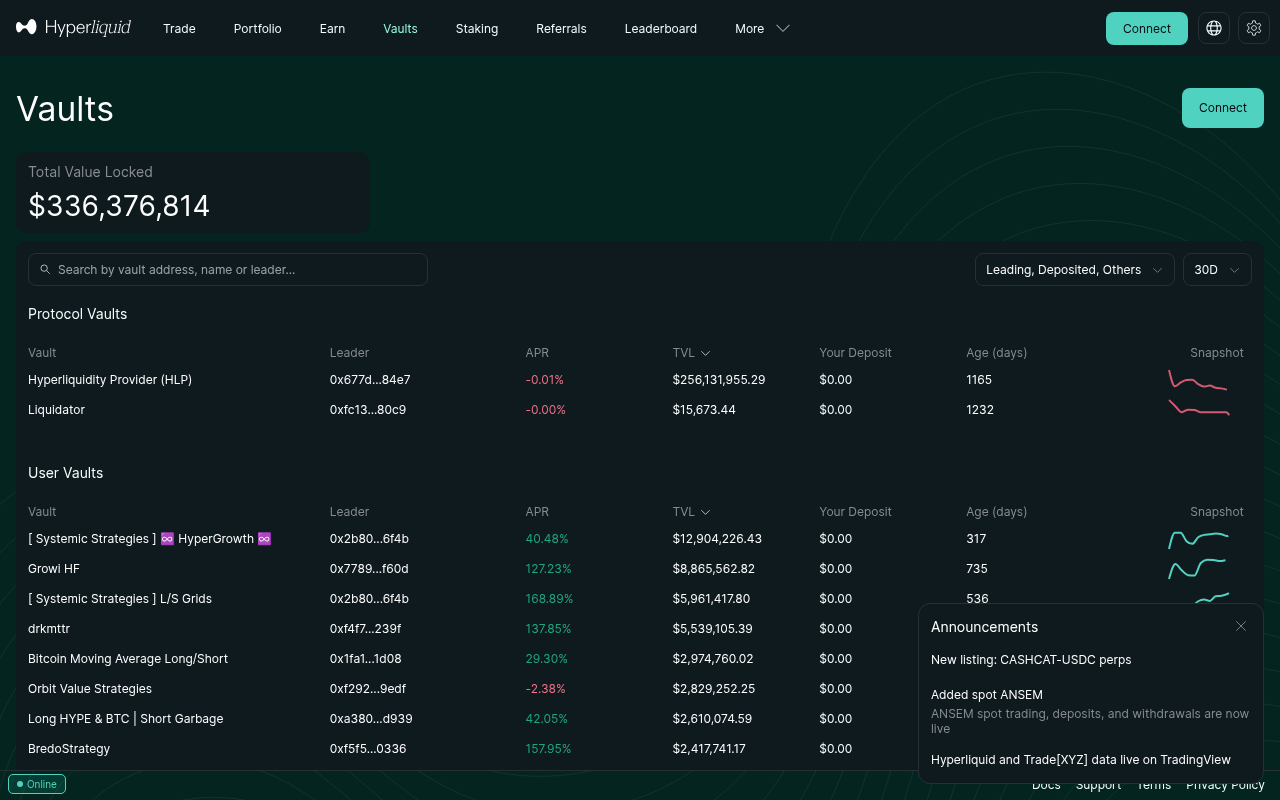
There is no single "HLP APY." Returns are lumpy and event-driven. The most reliable way to think about HLP is to look at the actual on-chain P&L curve rather than any single APY headline. Public analytics that aggregate HLP performance suggest a trailing-12-month CAGR in the low-20s as of Q1 2026, with lifetime CAGR considerably higher when measured from the early days of a smaller asset base (OnchainTimes HLP/JLP analysis, as of 2026-Q1). Because the asset base has scaled meaningfully, expect trailing returns to compress further over time as the same dollar of liquidation flow is shared across more depositors.

For what it's worth, my own HLP position โ€” opened summer 2025 and held continuously since โ€” has tracked roughly in line with the published trailing curve. Two weeks stand out: one was the well-known whale liquidation on 1 February 2026 (more on that below), where my balance jumped visibly the next morning; the other was a flat-to-negative stretch in late 2025 that I had to remind myself was the *normal* shape of this product before topping up again.

The "lumpy" qualifier is not abstract. On 1 February 2026, the public liquidation of a $700M whale position (widely covered as the "1011 Insider Whale" event) reportedly added roughly $15M of profit to HLP in 24 hours โ€” a single-day return north of 5% (KuCoin News, as of 2026-02). Conversely, in March 2025 an adversarial whale strategically pulled margin to force a liquidation HLP could not absorb cleanly, leaving a multi-million-dollar temporary drawdown that was widely discussed in the Hyperliquid community at the time.

The takeaway: HLP returns are structural alpha plus occasional whiplash. If you cannot stomach a 5% drawdown in a week, this is not the product for you. Always cross-check the current trailing P&L on the Hyperliquid app vaults page before depositing โ€” that is the source of truth, not any third-party screenshot.

HLP lock-up โ€” read the example, then read it again

The protocol-vaults page is explicit: HLP enforces a 4-day lock from your most recent deposit. The docs give the example: deposit on Sep 14 at 08:00, earliest withdraw Sep 18 at 08:00.

This caught me personally the first time I topped up. I thought the cooldown applied only to the new tranche; in fact every top-up resets the clock for the *entire balance*. Result: I sat through four extra days I had not planned for, on a position I had owned for months. If you want to dollar-cost-average into HLP, you are choosing to stay liquidity-constrained as the price of consistency. Now I batch top-ups quarterly instead of monthly, exactly to avoid resetting the clock more than I need to.

HLP fees and slippage

HLP has no management fee, no performance fee, and no leader cut. Withdrawal does carry slippage as the vault closes any open positions tied to your share. From the depositor docs: *"There may be some slippage as you withdraw and open positions are closed."* In practice this is usually trivial โ€” my one withdrawal so far cost a handful of basis points, no more. But during stressed market conditions (the same conditions where you would most want to withdraw) it can be material. Plan accordingly.

2. User vaults โ€” copy trading with on-chain transparency

User vaults are Hyperliquid's spin on copy trading. Anyone can become a vault leader by depositing 100 USDC and paying a one-time 10,000 USDC vault-creation fee to the protocol (for-vault-leaders-legacy docs). Once live, depositors subscribe with one click; their funds are pooled with the leader's and traded by the leader's strategy.

The profit-share economics are simple and identical for every user vault: the leader receives 10% of profits, depositors keep 90%. The leader is also required to maintain at least 5% personal skin in the game at all times โ€” they cannot withdraw down to zero.

Lock-up: 1 day, the shortest of the three

User vaults have only a 1-day lock from your most recent deposit, far shorter than HLP. That makes them suitable if you are evaluating leaders or expect to rotate. I rotated mine out after about eight weeks โ€” once the leader's drawdown profile started widening, the 1-day lock made it easy to exit cleanly, which is exactly the value proposition.

What user vaults actually pay (and why "average APY" is meaningless)

Unlike HLP, there is no aggregate user-vault APY because every vault is a discretionary strategy run by a different person. The Hyperliquid vaults dashboard at coinglass.com lists the actual TVL, depositor count, and trailing PnL for individual vaults โ€” that is the data set you should look at before subscribing, not aggregate articles.

Three concrete due-diligence checks I now run before depositing into any user vault:

๐Ÿ’ก Hyperliquid

Like what you're reading? Try it yourself โ€” this link supports ChartedTrader at no cost to you.

Open a Hyperliquid account โ†’
๐ŸŽ You receive: 4% fee discount on first $25M volume ยท per account, lifetime

1. Inception date. A 90-day track record is not a track record. Anything younger than ~6 months in live markets is a marketing pitch, not data. The vault I subscribed to had ~10 months of history; even that turned out to be borderline.

2. Drawdown depth. Not "max drawdown" โ€” look at the worst week. The 10% profit share is fine when the vault is up; it does nothing to compensate you for sitting through a 30% drawdown. 3. Leader's own ownership trajectory. The 5% floor is the rule, but the *direction* matters. A leader who is steadily reducing their share is a flag worth investigating.

Bonus check: read the trades. Hyperliquid vaults are fully on-chain, so every fill the vault has ever taken is auditable from the dashboard. This is one of the few corners of crypto where "trust but verify" is literally enforced by infrastructure โ€” and I used that property heavily before deciding the strategy was no longer something I wanted exposure to.

Liquidity caveat depositors miss

When you withdraw from a user vault, the leader has to close down a proportional slice of the open positions. If the vault is heavy in low-liquidity perps, your withdrawal slippage can eat a meaningful chunk of your share. This is structurally similar to HLP slippage but tends to be worse on user vaults because the strategies typically run more concentrated books.

3. HYPE staking โ€” the dual-yield product

HYPE staking is fundamentally different from the two vault products. You are not depositing USDC and earning USDC โ€” you are staking the protocol's native token to earn two separate streams:

Reward math

From the Hyperliquid staking docs: the emissions rate is *"inversely proportional to the square root of total HYPE staked."* At ~400M HYPE staked, that yields approximately 2.37% APY, redelegated daily (compound). If staked supply doubles, the yield drops by a factor of โˆš2 โ€” i.e. to ~1.68% APY at 800M.

Compared to HLP's trailing returns, that is hilariously low in isolation. But that ignores half the product: the fee discount.

The fee-discount tier system

This is the underrated half of HYPE staking. Per Hyperliquid's trading fees documentation, staked HYPE unlocks tiered fee discounts:

TierHYPE stakedTrading fee discount
Wood>105%
Bronze>10010%
Silver>1,00015%
Gold>10,00020%
Platinum>100,00030%
Diamond>500,00040%
This is a permanent discount as long as the stake remains. For a high-volume trader, the implicit yield from saved fees can dwarf the headline 2.37% emissions rate. It also stacks with the 4% referral fee discount and any HIP-1 maker rebates the venue offers โ€” see my breakdown of stacking fee discounts on Hyperliquid for the full math.

A worked example, close to my own setup: a trader doing $10M monthly volume at the standard taker fee of 0.045% would pay ~$4,500/mo in fees. The Silver tier (1,000 HYPE staked) saves them 15%, or ~$675/mo, on top of the ~2.37% emissions APY on their staked HYPE. The fee saving alone often pays for the staked position within a few months for active traders โ€” which is why HYPE staking is rarely the right product for someone who only trades occasionally. I personally sit in the Bronze tier (>100 HYPE), where the 10% discount is meaningful at my volume but the math says I should ladder up to Silver before I worry about anything else.

Unstaking delay: 7 days

The friction is real. Once you decide to exit, transferring HYPE from your staking account to your spot account takes 7 days. The example in the docs: initiate transfer March 11 at 08:00:00 UTC, finalize March 18 at 08:00:01 UTC. You may also have at most 5 pending withdrawals in the queue at any one time. I've sat through one 7-day clock during a notably volatile week and it is exactly as uncomfortable as it sounds โ€” you are watching the price move with no ability to act on the staked balance.

Permanent linking โ€” read this twice

A very Hyperliquid-specific quirk: linking a staking account to your trading account for the fee discount is permanent. From the docs: *"Linking is permanent. Unlinking is not supported."* Choose the linkage carefully โ€” there are no take-backs. I linked mine to my main trading wallet rather than a sub-account specifically because I never want to be in the position of having my fee tier stranded on the wrong key.

HYPE price exposure

The largest risk to staking is not technical, it's market: your "yield" is denominated in HYPE. If HYPE drops 50%, the 2.37% APY plus your fee savings does not save you. For context on HYPE's tokenomics and burn dynamics, see my explainer on HYPE buybacks now exceeding staking emissions.

If you would rather get HYPE exposure without the validator/staking complexity, an alternative is a vehicle like the recently filed Grayscale HYPE ETF โ€” though as I covered in the HYPE ETF vs direct holdings comparison, the ETF cannot capture the staking yield, which is exactly the point of going on-chain in the first place.

Side-by-side: which product for which goal?

The three products serve genuinely different goals. Here is how I map them:

GoalBest fitWhy
Park stablecoins, earn USDC yield, comfortable with episodic drawdownHLPNo leader fee, structural protocol alpha
Capture skill of a specific trader you trustUser vault10% leader share is the only way to get this exposure on-chain
Active perpetuals trader with monthly volume >$1MHYPE stakingThe fee discount alone usually outweighs the 2.37% emissions yield by an order of magnitude
You want HYPE upside *and* are an active traderHYPE staking + active tradingStack the price exposure with the fee discount
You want to avoid HYPE price exposure entirelyHLP onlyUSDC-denominated; no token risk
A common pattern among power users โ€” and the one I run โ€” is to combine HLP and HYPE staking rather than treat them as alternatives. The two products are uncorrelated: HLP returns track liquidation flow and market-making P&L, while HYPE staking returns track token emissions and personal trading volume. There is no rule that says you must pick one.

Common pitfalls (in order of how often I see them online โ€” and how often I made them myself)

1. Topping up HLP and forgetting it resets the lock. A new deposit pushes the entire balance's earliest withdrawal date to deposit + 4 days. If you DCA weekly, you will essentially never be able to withdraw without sitting through a 4-day cooldown. (Made this mistake. Once.)

2. Treating user-vault APY screenshots as forward returns. A vault that returned 60% in the last 60 days has near-zero predictive value about the next 60. Always check inception date and worst-week drawdown. 3. Staking HYPE without first activating the fee discount. Emissions yield alone is ~2.37%. Without the fee tier, you are leaving the more valuable half of the product on the table. 4. Linking the wrong wallet. The trading-account โ†” staking-account link is permanent. I've seen users in the Hyperliquid Discord realize this only after creating a sub-account they meant to keep separate. 5. Forgetting the 7-day unstake delay before a known event. If you want HYPE liquid before a token unlock, listing, or macro event, you must initiate the unstake at least 7 days prior. There is no fast-exit option. 6. Comparing HLP to centralized "earn" products. A CEX yield product is collateralized by the platform's balance sheet. HLP's drawdowns are passed through directly to depositors. They are not the same risk class.

Verdict

If you are picking exactly one for the next 12 months:

For most active users, the right answer is some combination of the three rather than a single pick โ€” which is what I run today and intend to keep running. The 4-day HLP lock and the 7-day HYPE unstake mean you should size each allocation assuming you cannot touch it for at least a week.

If you don't yet have a Hyperliquid account, the first step is wallet onboarding rather than the vault page itself โ€” my Hyperliquid getting-started guide walks through wallet connection and bridging USDC.

Ready to evaluate the vaults dashboard and the staking page side by side? Open a Hyperliquid account โ€” using a referral link unlocks the standing 4% trading-fee discount on the first $25M of personal volume, which stacks with every staking tier above.

> Disclosure: This article contains an affiliate referral link to Hyperliquid (RICH888), which is the same code I trade under. Sign-ups via that link contribute referral rewards to me at no cost to you and qualify you for the 4% trader-side fee discount on initial volume. Yields and fee schedules quoted are accurate to the linked first-party sources as of April 2026 and may change without notice โ€” verify the current schedule on the Hyperliquid docs before depositing.

๐Ÿงฎ Free Hyperliquid calculators

Fee Calculator โ†’
Hyperliquid vs centralized exchange fee comparison
PnL & Liquidation โ†’
Perp PnL + liquidation price
Position Size โ†’
Risk-aware position sizing for HL perps
Hyperliquid

Ready to get started? Use the link below โ€” it helps support ChartedTrader at no cost to you.

Open a Hyperliquid account โ†’
๐ŸŽ You receive: 4% fee discount on first $25M volume ยท per account, lifetime
๐Ÿ“ˆ

About the author

I'm a systematic trader running live strategies on IB (USDJPY momentum) and Hyperliquid (crypto perps). Every tool reviewed here is something I've used with real capital. Questions? Reach out.

๐Ÿ“š Related Articles

โš–๏ธ Comparisons

IBKR vs Tastytrade Algo Trading: Which Broker Wins (2026)?

IBKR vs Tastytrade for algo and systematic trading in 2026: APIs, fees, asset coverage, margin, and latency compared from public docs and live experience.

May 1, 2026 โฑ 14 min read
โš–๏ธ Comparisons

Hyperliquid vs Bybit Perpetuals: DEX vs CEX Compared (2026)

Hyperliquid vs Bybit perpetuals compared: custody, KYC, fees, leverage, and on-ramps. Cited 2026-04 numbers and a real trader's take on which fits which profile.

May 1, 2026 โฑ 12 min read
โš–๏ธ Comparisons

Best Pine Script Tool 2026: TradingView vs TrendSpider

Pine Script runs only on TradingView โ€” here's whether that's still the right home for charting in 2026, or if TrendSpider's automation-first approach fits coders better.

April 30, 2026 โฑ 12 min read

๐Ÿ“ฌ Get weekly trading insights

Real trades, honest reviews, no fluff. One email per week.