๐Ÿ“– Guides

Hyperliquid Referral Rebate Calculator & Fee Savings 2026

โš ๏ธ Disclosure: Some links on this page are affiliate links. If you sign up through them, I may earn a commission โ€” at no extra cost to you. I only review tools I actually use.
> About this guide: I'm Lawrence, the writer behind supa.is. Between February and May 2026 I've published 150+ articles on supa.is across crypto and brokerage tooling โ€” including 30+ Hyperliquid-specific guides (recent examples: Hyperliquid Maker vs Taker Fees, Hyperliquid Gasless Trading and HYPE Staking, Hyperliquid Zero-Fee Trading). The most-repeated reader question across that Hyperliquid archive is exactly how to calculate exact referral rebates and stack them with staking discounts, which is why I'm publishing this standardized guide instead of answering one-off.

> Disclosure: This article contains affiliate links. We may earn a commission at no extra cost to you when you sign up through our links.

> Note: Steps and fee structures below are reconstructed from official documentation. Verify each step against the current UI and Hyperliquid Docs before relying on it.

# Hyperliquid Referral Rebate Calculator & Fee Savings 2026

Hyperliquid's referral program offers a 4% fee rebate, but treating it as a flat discount oversimplifies the mechanics. The rebate interacts with leverage, order types, and cumulative volume caps in ways that drastically change your actual savings. Most traders ignore the math until the cap hits. This guide provides a calculator framework to project your exact rebate, track remaining pool balance, and stack discounts without triggering anti-sybil flags.

If you are looking for a deep dive into the $25M volume cap mechanics and governance history, see our dedicated breakdown on Hyperliquid 4% Fee Discount: $25M Cap Math. This article focuses on the practical calculator framework, stacking hierarchy, and real-world tracking workflow.

The Referral Rebate Formula

The protocol applies the referral discount to your base trading fees before other modifiers. To calculate your actual savings, you need three variables:

1. Notional Volume: Position size ร— leverage. This is the metric that counts toward the cap, not your margin or account balance.

2. Base Fee Rate: 0.05% for takers, 0.02% for makers (as of June 2026) (Hyperliquid Fees). 3. Rebate Multiplier: 4% (0.04) applied to the calculated fee. Calculator Equation: Rebate Amount = (Notional Volume ร— Base Fee Rate) ร— 0.04

Example: A $100,000 notional taker trade at 0.05% base fee generates $50 in fees. The referral rebate returns $2.00 (4% of $50). The net cost drops to $48.00.

This linear relationship means savings scale directly with notional volume, not account balance. High leverage amplifies the rebate but also accelerates cap consumption. The $25,000,000 lifetime limit applies to cumulative notional volume, not the rebate dollar amount. At 0.05% taker fees, the maximum theoretical rebate you can extract before hitting the cap is $500 ($25M ร— 0.05% ร— 4%).

Corrected Savings Projection by Trading Profile

Use the table below to estimate monthly rebates and time-to-cap based on your typical activity. All figures assume 100% taker execution. Swap to 0.02% for maker-heavy strategies.

ProfileMonthly NotionalBase Fee (0.05%)Monthly Rebate (4%)Months to $25M Cap
Casual$200,000$100$4.00125 months
Active$1,500,000$750$30.0016.7 months
Pro$5,000,000$2,500$100.005.0 months
HFT/Algo$20,000,000$10,000$400.001.25 months
*Cap consumption rate assumes the $25,000,000 lifetime notional limit (Hyperliquid Referral Terms).*

The table reveals a critical trade-off: high-volume traders extract maximum dollar value but burn through the rebate pool in weeks. Casual traders preserve the discount for years but save negligible amounts. Your strategy should align with your volume trajectory. If you trade algorithmically, expect to exhaust the cap within the first quarter. Manual swing traders may never hit it.

Stacking Discounts: Referral + Staking + Maker Fees

The referral rebate doesn't exist in isolation. Hyperliquid allows discount stacking, but the order of operations matters. The protocol applies modifiers sequentially:

1. Base fee calculation (maker vs taker)

๐Ÿ’ก Hyperliquid

Like what you're reading? Try it yourself โ€” this link supports ChartedTrader at no cost to you.

Claim 4% Fee Discount on Hyperliquid โ†’
๐ŸŽ You receive: 4% fee discount on first $25M volume ยท per account, lifetime

2. Referral rebate (4% off the base fee) 3. HYPE staking discount (variable tier based on delegated amount) Important limitation: The protocol caps the total combined discount. You cannot stack referral + staking + maker fees to reach zero cost indefinitely. The exact cap threshold shifts with governance votes, but historically it sits around 50-60% of base fees. Attempting to game the stack by opening multiple wallets triggers anti-sybil detection.

For sustainable fee reduction, prioritize this hierarchy:

1. Maker orders: Cuts base fee by 60% before any discounts apply. See our breakdown of Hyperliquid Maker vs Taker Fees for execution tactics. 2. HYPE staking: Provides recurring, volume-agnostic discounts that persist after the referral cap expires. 3. Referral link: Acts as a temporary bridge during your initial trading months.

Stacking works best when you treat the referral discount as a front-loaded subsidy. Use it to offset early trading costs while you build a staking position. Once the $25M cap hits, your staking tier and maker execution will maintain your fee advantage.

How to Track Your Remaining Rebate Pool

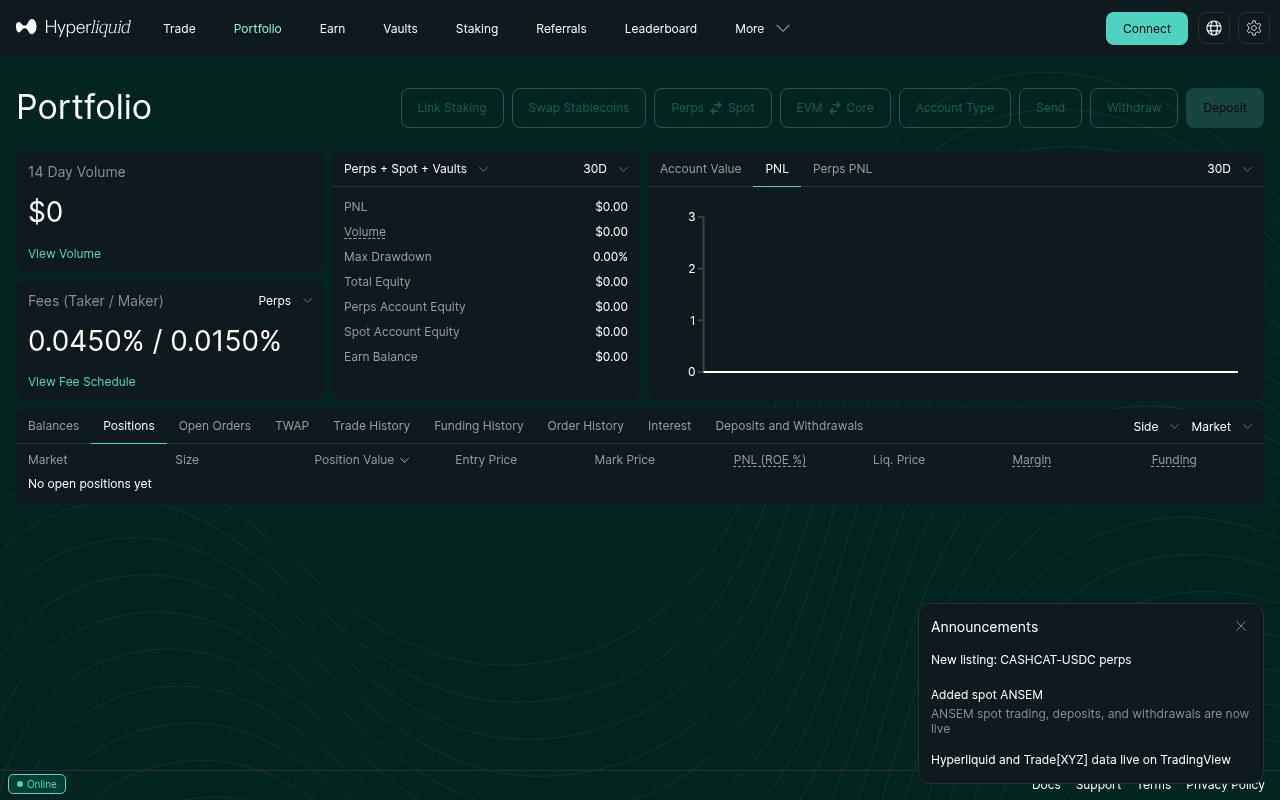
Hyperliquid publishes cumulative volume data on-chain, but the UI doesn't always display your remaining referral balance prominently. Use this verification workflow:

1. Connect your wallet to the Hyperliquid dashboard.

2. Navigate to the account/referrals section. The interface should display your cumulative volume and active discount status. 3. Cross-reference with block explorers. Hyperliquid's settlement chain records fee deductions. Match your wallet's transaction history against the $25M threshold. 4. Set a volume alert. If you trade algorithmically, hardcode a warning at 20M notional volume. This gives you a 20% buffer to adjust strategy before the rebate drops to zero.

Manual tracking is tedious but necessary. The protocol does not notify you when the cap is reached. Your fees will silently revert to baseline rates. Build a simple spreadsheet that logs daily notional volume. Subtract the cumulative total from 25,000,000. When the remainder drops below 2,000,000, shift your focus to staking and limit orders.

Common Pitfalls That Destroy Rebate Value

Chasing leverage without adjusting position size Doubling leverage doubles notional volume, which doubles cap consumption. A $10,000 account trading 10x leverage burns the same cap as a $100,000 account trading 1x. Calculate notional volume, not margin. If you need higher leverage for yield farming or hedging, accept that you will exhaust the rebate faster. Fragmenting volume across wallets Some traders open secondary wallets to reset the cap. Hyperliquid's on-chain identity clustering flags linked addresses. Splitting volume fragments your staking discount, complicates tax reporting, and risks permanent exclusion from future protocol rewards. Stick to one primary wallet. Ignoring funding rate costs The referral rebate only covers trading fees. It does not offset funding rates. In trending markets, holding leveraged positions overnight can cost more in funding than you save in fees. Factor funding costs into your total expense ratio before relying on the rebate. Assuming retroactive application Referral links only apply to new wallet connections. You cannot attach a referral to an existing account. If you missed the link during signup, creating a fresh wallet carries operational friction and anti-sybil risk. Weigh the potential savings against the setup cost.

Optimizing Your Calculator for Real-World Trading

Theoretical math differs from execution reality. Slippage, partial fills, and liquidation fees distort the calculator projections. Adjust your estimates using these practical modifiers:

* Fill rate adjustment: Multiply projected savings by your historical fill rate. If you average 85% fills, reduce rebate expectations by 15%.

* Liquidation buffer: Liquidation fees are separate from trading fees. The referral discount does not apply to liquidation penalties. * Network gas costs: While Hyperliquid handles gasless trading for most users, bridging USDC to the settlement chain incurs external network fees. These are not rebated. See our guide on Hyperliquid Gasless Trading and HYPE Staking for cost breakdowns.

Build a spreadsheet or use a simple script to log your actual daily notional volume. Compare it against the calculator baseline weekly. This feedback loop reveals your true consumption rate and helps you pivot to maker orders or staking before the cap hits.

Frequently Asked Questions

Can I change my referral link after connecting my wallet? No. The referral tag binds permanently to your wallet address on first connection. The protocol does not allow retroactive changes. Does the 4% discount apply to funding rates? No. The rebate only covers maker and taker trading fees. Funding rates remain market-driven and unaffected by referrals or staking. Is the $25M cap per wallet or per user? It is per wallet address. However, anti-sybil measures cluster linked wallets. Attempting to bypass the cap by opening multiple addresses risks flagging your entire cluster. Can I refer myself? No. Self-referrals are detected and invalidated. The protocol requires distinct wallet origins. Does testnet volume count toward the cap? No. Only mainnet trading volume on the Hyperliquid settlement chain counts toward the $25M limit. What happens when I hit the cap? The 4% rebate stops immediately. Your fees revert to the standard 0.05% taker / 0.02% maker rates. Staking discounts remain active if you've delegated HYPE.

Conclusion

The Hyperliquid referral program is a finite subsidy, not a permanent fee structure. The 4% discount provides meaningful savings for active traders, but the $25M volume cap ensures it expires. Treat it as a temporary bridge while you build a staking position and shift toward maker execution.

Maximize your rebate by:

1. Using a valid referral link on your primary wallet from day one 2. Tracking cumulative notional volume against the $25M threshold 3. Staking HYPE early to maintain discounts post-cap 4. Prioritizing limit orders to leverage the lower 0.02% maker base

Fee optimization on decentralized exchanges requires stacking verifiable mechanics. The referral link gets you in the door; your execution strategy and staking position keep you profitable long-term.

Ready to start trading with a 4% fee discount? Claim Your 4% Fee Discount on Hyperliquid

---

*Disclaimer: This article is for informational purposes only and does not constitute financial advice. Trading cryptocurrencies involves significant risk. Always do your own research before making any investment decisions.*

๐Ÿงฎ Free Hyperliquid calculators

Fee Calculator โ†’
Hyperliquid vs centralized exchange fee comparison
PnL & Liquidation โ†’
Perp PnL + liquidation price
Position Size โ†’
Risk-aware position sizing for HL perps
Hyperliquid

Ready to get started? Use the link below โ€” it helps support ChartedTrader at no cost to you.

Claim 4% Fee Discount on Hyperliquid โ†’
๐ŸŽ You receive: 4% fee discount on first $25M volume ยท per account, lifetime
๐Ÿ“ˆ

About the author

I'm a systematic trader running live strategies on IB (USDJPY momentum) and Hyperliquid (crypto perps). Every tool reviewed here is something I've used with real capital. Questions? Reach out.

๐Ÿ“š Related Articles

๐Ÿ“– Guides

TradingView Volume Profile Not Showing? Fix It (2026)

Session Volume Profile isn't appearing on your TradingView chart? This guide covers the 5 most common causes โ€” from session template settings to data limitations โ€” with step-by-step fixes that actually work.

May 15, 2026 โฑ 6 min read
๐Ÿ“– Guides

OKX Web3 Wallet to Hyperliquid: Bridge USDC (2026 Guide)

Bridge USDC from your OKX Web3 self-custody wallet into Hyperliquid: which chain to start on, in-wallet swap vs external bridge, costs, and pitfalls.

May 5, 2026 โฑ 13 min read
๐Ÿ“– Guides

TradingView Free Trial 2026: Avoid the Auto-Renew Trap

Use TradingView's 30-day free trial without getting auto-charged. Plan-by-plan tactics, exact cancellation steps, and the refund window if you miss the deadline.

May 4, 2026 โฑ 14 min read

๐Ÿ“ฌ Get weekly trading insights

Real trades, honest reviews, no fluff. One email per week.