This review compares the three dominant perp DEXs of 2026 — Hyperliquid, dYdX, and GMX — from the perspective of someone who actually clicks the "Confirm Trade" button.
The Perp DEX Landscape in 2026
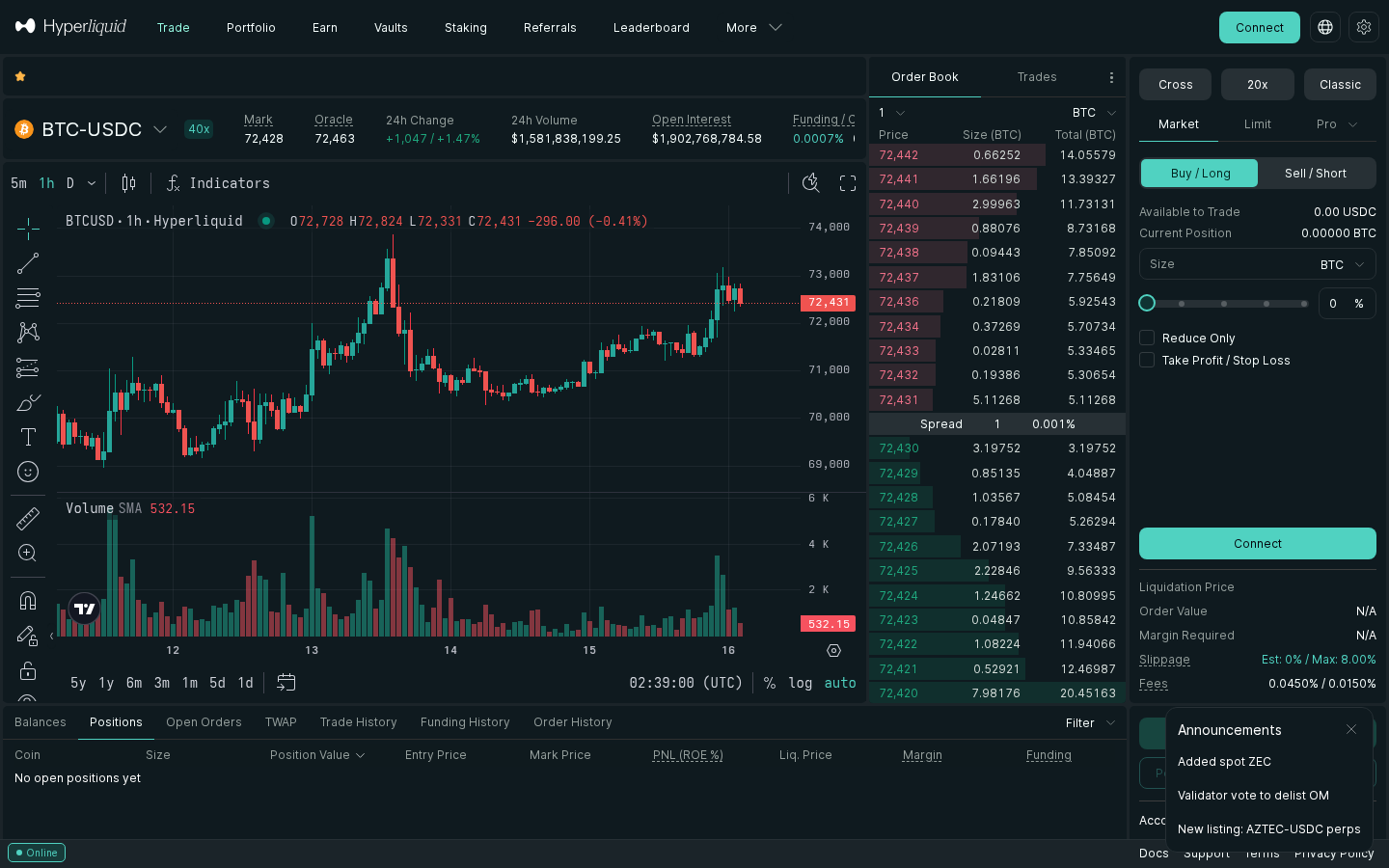
Decentralized perpetual futures trading is approaching $10 billion in daily volume as of early 2026. That's not a typo — what was once a niche DeFi experiment is now a serious trading venue.
As of 2026-04, Hyperliquid dominates with over 70% market share among perp DEXs, boasting $2.8 billion in TVL. dYdX, the veteran that pioneered on-chain perps, holds around $327 million TVL on its own app-chain. GMX, the DeFi darling that popularized "real yield," maintains roughly $152 million TVL across Arbitrum and Avalanche.
But market share isn't everything. Each platform serves a different type of trader. Let me break down what actually matters when you're placing trades.
Hyperliquid: The Speed King
Hyperliquid runs its own L1 blockchain (HyperBVM) purpose-built for trading. The result? Sub-second order matching that genuinely feels like a centralized exchange.
What I experienced firsthand:I started my Hyperliquid trading experiment in February 2026 with $100 USDT. My first trade was an ETH long during a flash crash — ETH dropped from $2,300 to $2,119 before rebounding. I caught the V-shaped recovery, entering at $2,298.60 and exiting at $2,300.80. The execution was instant. No waiting for block confirmations, no gas fee anxiety during volatile moments.
Over multiple BTC trades — including a short that got stopped out, and several longs in the $67,000–$68,000 range — the fills were consistently tight. When I placed a limit order, it sat on the book like a real exchange. When I market-sold, slippage was minimal even during fast moves.
Fees:- Taker: 0.045% base (as of 2026-04) (decreasing with volume)
- Maker: 0.015% base (as of 2026-04) (can become rebates at higher tiers)
- No gas fees for trading — zero. You only pay gas for deposits/withdrawals.
- CEX-level speed on a DEX — order book model with real limit orders
- Zero gas fees per trade (this adds up fast)
- 150+ perpetual markets (as of 2026-04)
- No KYC required
- Built-in sub-accounts for risk isolation
- New L1 chain means less battle-tested security history
- Deposits require bridging (typically from Arbitrum), which takes ~20 minutes (as of 2026-04)
- The JELLY incident in early 2025 raised questions about validator intervention
- UI can be overwhelming for DeFi newcomers — it looks and feels like a pro trading terminal
dYdX: The Battle-Tested Veteran
dYdX has been around since 2017, making it the grandfather of on-chain perps. After migrating from StarkEx (Ethereum L2) to its own Cosmos-based app-chain (dYdX Chain) in late 2023, it's now fully decentralized with an open-source order book.
What sets dYdX apart:dYdX Chain runs a fully on-chain order book validated by its own proof-of-stake network. Every order, cancellation, and fill is processed by validators — meaning no centralized sequencer or matching engine. This is philosophically the most "decentralized" of the three.
Like what you're reading? Try it yourself — this link supports ChartedTrader at no cost to you.
Start Trading on Hyperliquid →- Taker: 0.05% base (as of 2026-04)
- Maker: 0.02% base (as of 2026-04) (rebates possible at top tiers)
- Trading fee revenue goes to validators and stakers
- Longest track record in perp DEX space (since 2017)
- Fully decentralized order book (no centralized component)
- DYDX token staking earns trading fee revenue
- Governance-controlled parameters (withdrawal limits, market listings)
- Strong institutional recognition
- Higher base fees than Hyperliquid (0.05% vs 0.045% taker) (as of 2026-04)
- Lower leverage caps (20x vs 50x) (as of 2026-04)
- Fewer perpetual markets (~80 vs 150+) (as of 2026-04)
- The Cosmos migration fragmented some liquidity
- Withdrawal rate limits can be frustrating (max 1% of TVL per hour) (as of 2026-04)
GMX: The Yield Farmer's Perp DEX
GMX takes a fundamentally different approach. Instead of an order book, it uses a liquidity pool model (GM pools in v2) where traders trade against pooled assets. Liquidity providers earn real yield from trading fees — and during 2021–2022, those yields were spectacular.
What makes GMX unique:When you open a BTC long on GMX, you're not matching with another trader. You're borrowing from a pool of BTC deposited by liquidity providers. This means zero price impact on standard-size trades (the pool absorbs it), but it also means the protocol takes on directional risk.
Fees:- Open/Close: 0.04%–0.06% on v2 (as of 2026-04)
- Borrowing fee: variable, accrues hourly based on utilization (as of 2026-04)
- Network gas fees on Arbitrum/Avalanche (small but nonzero)
- Simple, clean interface — easiest to use of the three
- Zero price impact model for moderate position sizes
- Real yield for LPs (fees paid in ETH/BTC, not inflationary tokens)
- Multi-chain presence (Arbitrum, Avalanche, Ethereum, Base, BNB Chain)
- Battle-tested on Arbitrum since 2021
- Limited asset selection compared to Hyperliquid
- Pool model means liquidity caps — large positions can face issues
- Borrowing fees eat into profits on longer holds
- No native limit orders (must use third-party or market orders)
- LP yield has compressed significantly from the 2021–2022 highs
Head-to-Head Comparison
Execution Speed- Hyperliquid: Sub-second (own L1) ⭐
- dYdX: ~1 second (Cosmos chain)
- GMX: Block time dependent (Arbitrum ~0.25s)
- Hyperliquid: 0.045% ⭐
- dYdX: 0.05%
- GMX: 0.04–0.06%
- Hyperliquid: Zero ⭐
- dYdX: Minimal (Cosmos)
- GMX: ~$0.01–0.10 (Arbitrum) (as of 2026-04)
- Hyperliquid: 50x ⭐
- dYdX: 20x
- GMX: 25x
- Hyperliquid: 150+ ⭐
- dYdX: ~80
- GMX: ~50
- All three: No ⭐
- Hyperliquid: $2.8B ⭐
- dYdX: $327M
- GMX: $152M
What I Actually Recommend (Based on Real Trading)
After trading actively on Hyperliquid for nearly a month — executing shorts during breakdowns, longs on breakout signals, and managing trailing stops — here's my honest take:
Choose Hyperliquid if you're an active trader who values execution speed and low fees. The zero-gas-per-trade model is genuinely game-changing. When I'm scalping BTC during a volatile session and placing 4–5 trades in an hour, not paying gas each time saves real money. The order book depth on BTC and ETH is competitive with mid-tier centralized exchanges. Choose dYdX if you prioritize decentralization philosophy and want the most battle-tested protocol. If you're holding governance tokens and care about the "own your exchange" narrative, dYdX Chain delivers on that promise. It's also the safest choice for institutional traders who need the longest compliance track record. Choose GMX if you're primarily a liquidity provider looking for real yield, or a casual trader who wants the simplest interface. GMX v2's GM pools still offer attractive returns during high-volatility periods, and the multi-chain expansion means you can trade from whichever L2 you prefer. My pick: Hyperliquid wins for active trading. The combination of zero gas fees, sub-second execution, and 150+ markets makes it the most practical choice for anyone placing more than a few trades per week. I've personally grown a $100 account to over $216 on the platform — not because of leverage luck, but because the low friction lets me execute a systematic signal-based strategy without fees eating me alive.Getting Started on Hyperliquid
If you want to try Hyperliquid:
- You'll need USDC on Arbitrum (bridge from any major chain)
- Connect your wallet and deposit — takes about 20 minutes for the bridge
- Start small. I started with $100 and would recommend the same.
- Use limit orders when possible — the 0.015% maker fee (as of 2026-04) is significantly cheaper than 0.045% taker
Risk Disclaimer
Perpetual futures trading carries significant risk. Leverage amplifies both gains and losses. I've had multiple trades stopped out for small losses — it's part of the game. Never trade with money you can't afford to lose, and always use stop-loss orders. My $100 experiment is exactly that — an experiment with money explicitly allocated for risk.
The platforms compared in this article are decentralized protocols. Smart contract risk, oracle manipulation risk, and liquidity risk are all real. Do your own research before depositing funds.
*This article contains an affiliate link. If you sign up through our Hyperliquid link, we may earn a small commission at no extra cost to you. This does not influence our analysis — we recommend what we actually use.*
---
Just Signed Up? Here's What to Do Next
Hyperliquid: Follow our Hyperliquid setup guide — wallet connection, USDC bridging, and your first perps trade.---