About this guide: I'm Lawrence, the writer behind supa.is. Between February and May 2026 I've published 150+ articles on supa.is across crypto and brokerage tooling — including 30+ Hyperliquid-specific guides (recent examples: Cross Margin vs Isolated Margin, Portfolio Margin: How It Works, Funding Rate History & Cost Calculator). The most-repeated reader question across that Hyperliquid archive is exactly *how to calculate your liquidation price and maintenance margin*, which is why I'm publishing this standardized guide instead of answering one-off.
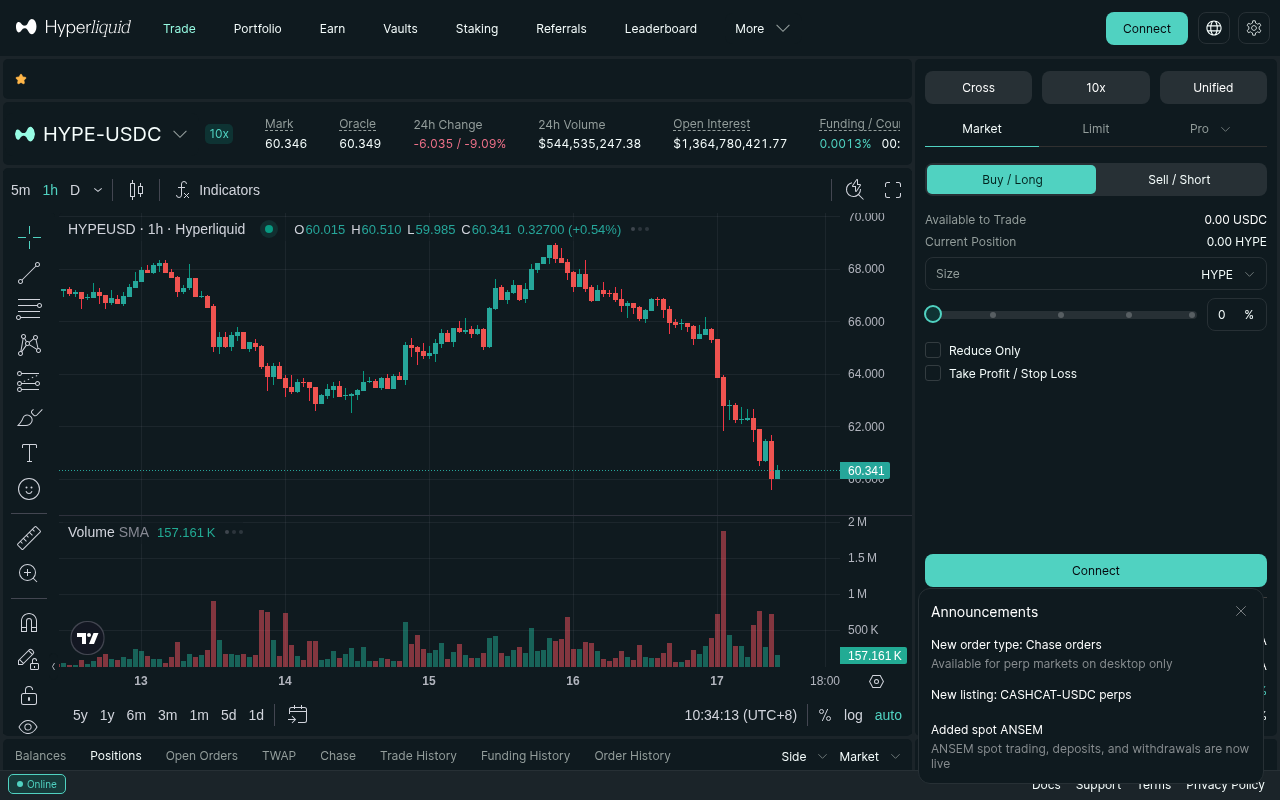
*Evidence: Logged-out mainnet public UI, captured and refreshed automatically each week. Official documentation.*
On Hyperliquid, your liquidation price is the line between a trade that hurts and a trade that wipes you out. Because the exchange runs on-chain, there is no support desk to call when the math goes against you. You need to understand maintenance margin well enough to size your own risk before you click the order button.
This guide breaks down three things: how Hyperliquid defines maintenance margin, the formula that turns your entry price, leverage, and position size into a liquidation price, and the practical habits that keep that price far enough away from the market. I'll also flag where the simplified mental math stops being accurate, because that gap is where most blown-up accounts live.
What Is Maintenance Margin on Hyperliquid?
When you open a leveraged perpetual, you post initial margin — the capital that backs the position. As the market moves against you, your equity shrinks. Maintenance margin is the floor: the minimum equity the system requires to keep the position open. If your equity falls below that floor, the position is liquidated automatically.
Two properties matter for the calculation:
- It is set per asset. Each perpetual carries its own maintenance margin rate. Volatile names carry higher rates than the majors, because a wider adverse move is more likely and the insurance fund needs more cushion.
- It scales with size. Hyperliquid uses tiered requirements: as your position's notional value crosses size thresholds, the effective maintenance margin rate rises. This caps how much concentrated risk any single position can put on the books.
$$ \text{Maintenance Margin} = \text{Position Notional Value} \times \text{Maintenance Margin Rate} $$
I won't quote specific rate values here, because they change with asset listings and tier updates. The current rate for any market is displayed in the trading UI and exposed through the API, so always read the live number rather than trusting a figure from an old blog post.
How Hyperliquid Calculates Your Liquidation Price
Your liquidation price is the market price at which your position's unrealized loss has eaten through everything except the maintenance margin. At that point the system closes the position to protect the insurance fund.
The simplified calculator formula
For quick estimates, the math reduces to one question: *how much can the price move before my loss equals my margin minus the maintenance buffer?*
Long position:$$ \text{Liquidation Price} \approx \text{Entry Price} - \frac{\text{Initial Margin} - \text{Maintenance Margin}}{\text{Position Size}} $$
Short position:$$ \text{Liquidation Price} \approx \text{Entry Price} + \frac{\text{Initial Margin} - \text{Maintenance Margin}}{\text{Position Size}} $$
Notice both directions use Initial Margin − Maintenance Margin. You can lose your margin down to the maintenance floor, no further. (A common mistake is adding the maintenance margin for shorts, which overstates the buffer.)
Like what you're reading? Try it yourself — this link supports ChartedTrader at no cost to you.
Trade on Hyperliquid →This is an estimate. The exchange's actual liquidation engine also accounts for open orders, funding, and the exact tier your size sits in, so treat the formula as a sanity check and the number shown in the order preview as the truth.
Worked example
Say you open a long on BTC:
- Initial margin: $1,000
- Leverage: 10x
- Position size: $10,000
- Entry price: $60,000
- Maintenance margin for this size tier: $100
So the market can fall roughly 9% before the position is liquidated. That 9% is your survival buffer. Now do the same math at 50x: the buffer shrinks to under 2%, and a routine wick takes you out. This is the entire leverage trade-off in one number.
Cross Margin vs. Isolated Margin: How It Changes Your Liquidation Price
Your margin mode decides which pool of funds backs the position, and therefore how far the liquidation price sits from your entry.
| Factor | Isolated Margin | Cross Margin |
|---|---|---|
| Collateral source | Only the margin allocated to this position | Your entire account balance |
| Liquidation price | Closer to entry (smaller buffer) | Further from entry (larger buffer) |
| Max loss on liquidation | The isolated margin you assigned | Potentially your whole account balance |
| Best for | Strict per-trade loss limits | Hedged books, hedging across positions, surviving wicks |
If you're new to the mechanics, our Cross Margin vs Isolated Margin guide goes deeper into when each mode fits. For most single-direction trades, isolated is the safer default: it caps your downside at the number you chose.
Where to Find Your Liquidation Price Without Doing the Math
You don't need to run the formula before every order. Hyperliquid displays the liquidation price directly in the trading interface:
- When you set your leverage and size in the order panel, the preview area shows the resulting liquidation price before you submit.
- On any open position, the position panel lists the current liquidation price alongside your entry, margin, and unrealized PnL.
- The same values are available through the API if you're building tooling.
How to Avoid Liquidation on Hyperliquid
Knowing the formula is half the job. The other half is behavior.
1. Never let liquidation be your exit plan
A liquidation happens at the worst possible moment — when the market is already moving against you, often with slippage. Place a stop-loss order at a price *above* your liquidation price so you exit on your terms first. Our stop-loss setup guide covers the mechanics.
2. Keep a real buffer, not a theoretical one
A position whose liquidation price is 3% away is one bad candle from death. Size trades so the liquidation price sits at a level you'd actually be comfortable watching, with room for the wicks that happen every session.
3. Watch funding rates on long holds
Funding is a recurring cost that quietly erodes your margin. If you're long and funding is negative, you pay every interval, and each payment pushes your effective liquidation price closer to the market. Our funding rate history and cost calculator guide shows how to quantify this before you hold.
4. Respect what max leverage actually means
At 100x, a 1% adverse move consumes your entire margin. High leverage isn't a strategy; it's a bet that the market never wicks against you. Most durable traders keep leverage low enough that a normal volatility day doesn't touch their liquidation price.
5. Know what happens when liquidation fails
If the insurance fund can't cover a liquidation — typically in extreme, fast markets — Hyperliquid falls back to auto-deleveraging, where profitable positions on the opposite side are closed to absorb the loss. It's rare, but it's the tail risk of high-leverage trading. Our ADL explainer covers how the ranking works. For the broader mechanics of liquidations on the platform, see Hyperliquid Liquidations Explained.
6. Larger traders: look at portfolio margin
If you run a diversified book, portfolio margin calculates requirements from the net risk of the whole portfolio rather than position by position, which can lower your effective maintenance margin and push liquidation prices further out. See our portfolio margin guide for how it works and who qualifies.
Risk Warning
Risk Warning: Crypto trading involves substantial risk of loss. Never invest more than you can afford to lose. This is not financial advice.
FAQ
How do I calculate my liquidation price on Hyperliquid manually?
UseEntry Price − (Initial Margin − Maintenance Margin) / Position Size for longs, and add instead of subtract for shorts. It's an estimate; the exact figure is always shown in the order preview and position panel.
What happens to my funds when I get liquidated?
Your position is closed automatically and you lose the margin allocated to it. In isolated mode that's only the isolated margin; in cross mode the loss can extend across your account balance. A liquidation fee may also apply on top.Can I add margin to a position to avoid liquidation?
Yes. Adding margin increases your equity relative to the maintenance requirement, which pushes the liquidation price further from the market. In cross mode your full balance already counts; in isolated mode you add directly to that position's margin.Does Hyperliquid have auto-deleveraging?
Yes. When a liquidation can't be covered by the insurance fund, Hyperliquid closes profitable opposite-side positions to absorb the deficit. It's rare and mostly a concern for high-leverage positions in extreme markets.How often do maintenance margin rates change?
Rates are tied to each asset and to position-size tiers, and they can be updated as markets change. Check the live rate in the trading UI or via the API rather than relying on a number from an article.---
If you're ready to trade with your liquidation price in mind, you can sign up through our link to join Hyperliquid's referral fee discount — we verified the exact discount rate and the $25M volume cap in our 4% fee discount breakdown. The 4% referral discount applies to the first $25M of eligible volume; Vault and sub-account activity is excluded.
Trade on Hyperliquid