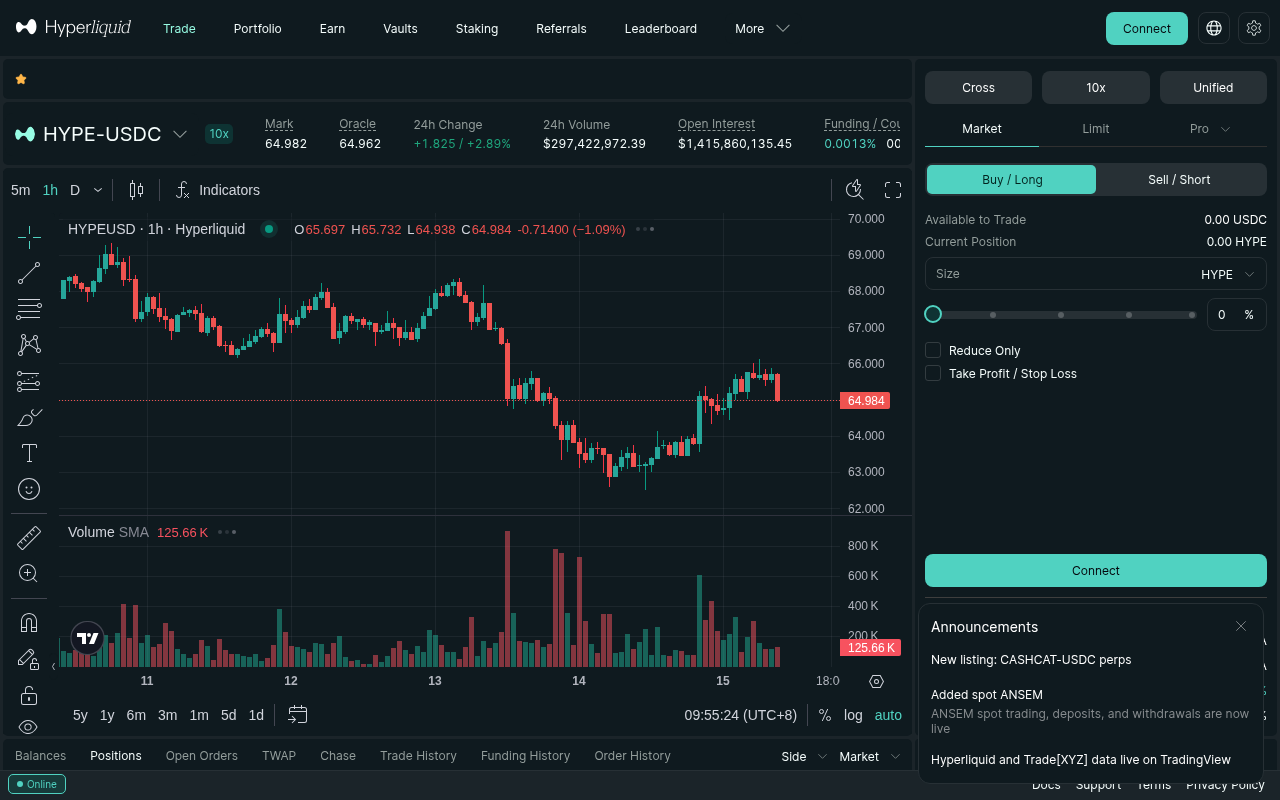
If you search "Hyperliquid vs OKX perpetuals," most pages give the same shallow checklist: fees, leverage, and a one-line "CEX easier, DEX safer" verdict.
That doesn't help when your real question is: where should I place actual trades this month?
I use both models in practice and care less about marketing claims than what happens when orders meet volatility. This review is based on real execution behavior and trading logs.
Quick answer
If you want the shortest version:
- Choose Hyperliquid if you prefer a perps-focused environment and transparency-oriented workflow.
- Choose OKX if you want a broader all-in-one exchange stack.
- Use both if you are serious and want venue diversification.
Why this comparison is different
Most comparison pages are feature checklists written without real fills. So here is one concrete anchor from my own historical log:
- I ran a small live Hyperliquid perp experiment starting from $100.
- One short BTC position (Trade #9) was opened around $65,164 and later closed near $65,254 after rebound pressure hit protective exit logic.
- Final result was small (about -$0.09) after nearly 48 hours.
CEX vs DEX mental model before feature comparison
The biggest mistake is treating Hyperliquid and OKX as identical products with different logos.
What a CEX like OKX optimizes for
- Account-centric experience (one account, many products)
- Product breadth (spot, perps, bots, earn, etc.)
- Operational convenience and familiar UX
What a DEX-style perp venue like Hyperliquid optimizes for
- Perps-first execution focus
- Transparent, onchain-verifiable activity model
- Lower dependence on centralized custody assumptions
Hyperliquid strengths
1) Focused execution environment
Hyperliquid is opinionated. If your routine is directional perps and short-horizon risk management, the focused environment reduces decision friction.
2) Cleaner process for strategy iteration
When testing signal logic, I care about repeatability. A perps-focused venue makes small, repeated experiments easier to run and journal.
3) Better for isolated strategy capital
If you prefer a one-job account setup (execute strategy, log results, avoid distraction), the narrower product scope can actually help discipline.
Hyperliquid weaknesses
1) Narrower product universe
If you want one account that handles every crypto workflow, Hyperliquid is less broad than a major CEX.
2) Onboarding comfort varies
Depending on your background, setup and funding flow may feel less familiar than a mainstream exchange app path.
3) Less ideal for all-in-one operators
If your operation depends on broad non-perp tooling in one place, this is not where Hyperliquid wins.
OKX strengths
1) Broad multi-product stack
OKX gives a full toolkit beyond perps. For multi-strategy users, this reduces operational fragmentation.
2) Better one-cockpit experience
Some traders want one login, one risk view, one app routine. OKX is usually stronger for that workflow.
3) More familiar mainstream UX
For newer users, centralized exchange UX can reduce setup mistakes and shorten time-to-first-trade.
4) Works well for rotating strategies
If you rotate between spot/perps/other tools, product breadth can be an edge.
OKX weaknesses
1) Higher custody trust assumption
This is the core centralized exchange tradeoff: convenience plus trust concentration.
2) Complexity can become noise
A broad platform can increase cognitive load. Too many features can encourage overtrading.
3) More features can reduce focus
If your goal is strict perps execution discipline, all-in-one environments may distract from process quality.
Head-to-head table
| Dimension | Hyperliquid (DEX-style perps) | OKX (CEX) |
|---|---|---|
| Core identity | Perps-focused venue | Multi-product centralized exchange |
| Best for | Active perp traders wanting focus | Traders wanting one platform for many workflows |
| Workflow style | Execution-centric, strategy-isolated | Portfolio-centric, ecosystem-centric |
| Product breadth | Narrower | Broader |
| Trust model | More onchain-verifiable assumptions | More centralized custody assumptions |
| Onboarding feel | Less familiar for some users | Usually more familiar |
| Distraction risk | Lower | Higher |
Practical lessons from real execution
Three lessons matter more than marketing claims:
1. Protective exits matter more than entry brilliance.
2. Small execution quality improvements compound over time. 3. Venue fit is strategy-dependent, not tribal.In short-horizon perp trading, tiny differences in slippage, reaction speed, and discipline can dominate outcomes over dozens of trades.
Which trader should choose Hyperliquid?
You are likely a fit if:
- You actively trade perps and want a focused venue.
- You care strongly about transparency-oriented workflow.
- You run isolated strategy experiments with strict logs.
Which trader should choose OKX?
You are likely a fit if:
- You want one exchange for multiple workflows.
- You value centralized convenience and broad tooling.
- You prefer mainstream onboarding and app structure.
Final verdict
There is no universal winner.
- Hyperliquid wins on focused perp execution and transparency-oriented workflow.
- OKX wins on ecosystem depth and centralized convenience.
Affiliate disclosure
This article includes affiliate links. If you register through them, I may earn a commission at no extra cost to you. I only recommend platforms I actually use or have evaluated in real trading workflows.
Risk warning
Trading perpetual futures is high risk. Leverage amplifies gains and losses. You can lose capital quickly. This content is educational and not financial advice. Do your own research and use risk controls (position sizing, stop-loss rules) appropriate for your profile.